Jingkieng Jri | Khasi & Jaintia Hills, Meghalaya
In an age of concrete and steel, where architecture seeks to conquer nature, the Khasi and Jaintia peoples of Meghalaya have spent centuries practicing a different philosophy: collaboration. Their living root bridges—locally called Jingkieng Jri—are not built but grown, not constructed but nurtured. These extraordinary structures represent perhaps humanity's most patient architectural achievement, where a bridge can take 15 years to become functional and 500 years to reach full maturity.
Walking across one feels less like crossing a man-made structure and more like being embraced by a living organism—because that's precisely what it is. As your feet touch the interwoven roots, moss-covered and pulsing with life, you're experiencing bio-engineering that predates modern sustainability concepts by centuries, yet surpasses most contemporary green architecture in both elegance and effectiveness.
THE SCIENCE OF GROWING BRIDGES: INDIGENOUS BIO-ENGINEERING
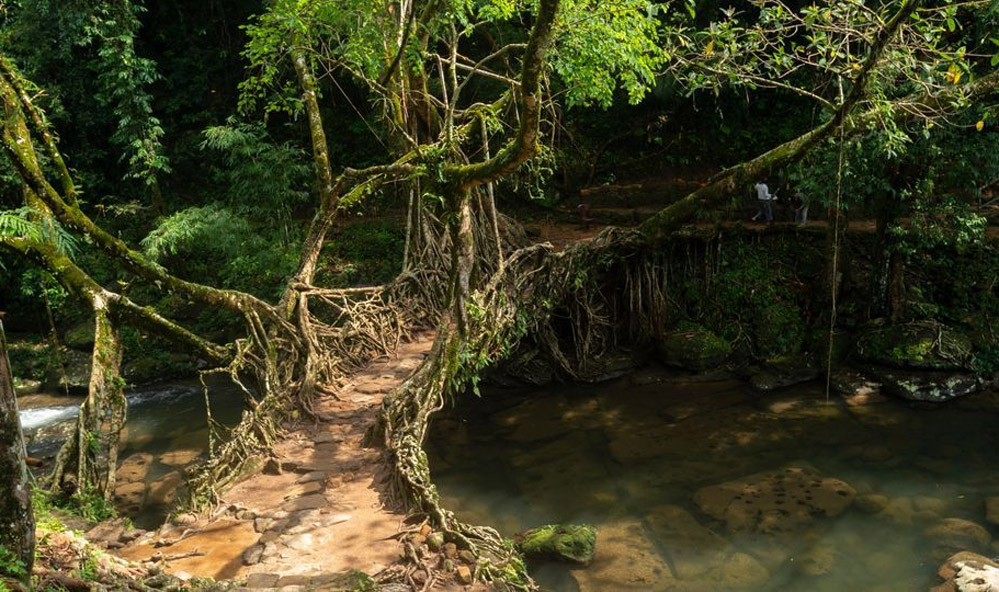
Living root bridges are created using the aerial roots of the rubber fig tree (Ficus elastica), a species uniquely suited to Meghalaya's subtropical monsoon climate. These trees produce secondary roots from their branches that grow downward, seeking soil and nutrients—roots that the Khasi people recognized could be guided, trained, and ultimately woven into functional structures.
According to a 2019 pilot study published in Nature Scientific Reports, these bridges demonstrate remarkable structural properties: "Living Root Bridges (LRBs) in the Indian State Meghalaya are grown with aerial roots of Ficus elastica... representing unique bio-engineering solutions that strengthen over time rather than deteriorate" Nature.
The Traditional Construction Process:
Tree Selection & Planting: Rubber fig trees are planted on both riverbanks, or existing trees are selected for their robust aerial root production.
Scaffolding Creation: Hollowed-out betel nut tree trunks or bamboo poles are positioned across the stream as temporary guides.
Root Training: Young, flexible aerial roots (typically 3-5 years old) are carefully threaded through the hollow trunks or tied to bamboo scaffolding.
Weaving & Binding: As roots reach the opposite bank, they're interwoven with each other and anchored into the soil, creating a mesh-like structure.
Growth & Strengthening: Over 15-20 years, the roots thicken, intertwine more densely, and fuse together through a process called inosculation Living Root Bridges.
Maturation: The bridge continues strengthening for decades or centuries, with some bridges estimated to be over 500 years old.
As a BBC Future article noted in 2021: "In a method perfected over centuries, the Khasi bridge builders weave aerial roots onto a bamboo or another wooden scaffolding, wheedle them across rivers, and train them to take root on the other bank" BBC.
Why They Work:
- Self-Strengthening: Unlike conventional bridges that deteriorate, living root bridges grow stronger with age
- Monsoon-Proof: The living structure flexes with water flow rather than resisting it
- Self-Repairing: Damaged sections naturally regenerate
- Load-Bearing: Mature bridges can support 50+ people simultaneously
- Longevity: Potential lifespan of 500+ years with minimal maintenance
FAMOUS BRIDGES: WHERE TO EXPERIENCE THIS MARVEL
There are approximately 11 functional living root bridges scattered across Meghalaya, primarily in the East Khasi Hills and West Jaintia Hills districts India Lost and Found Blog.
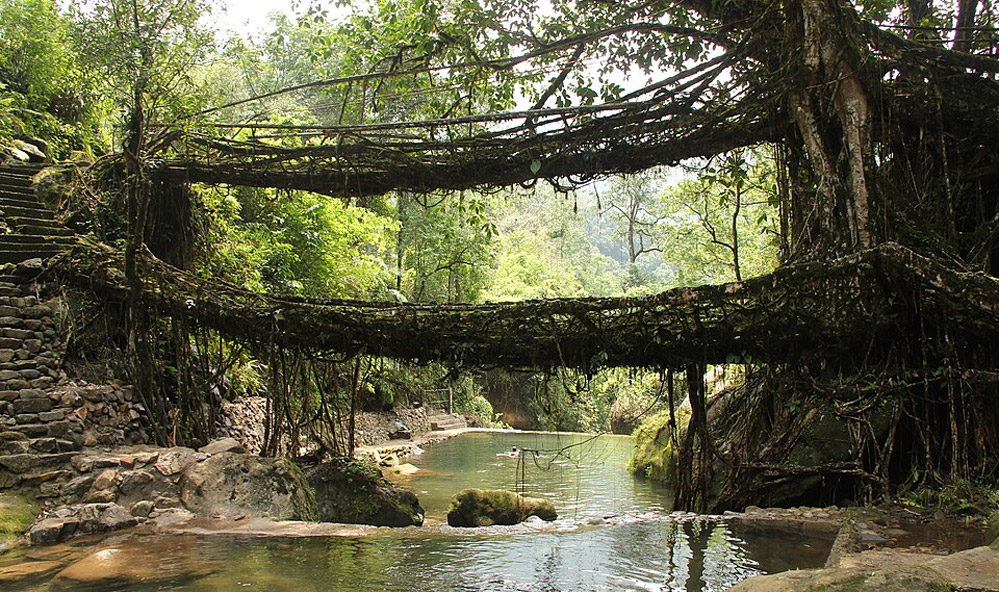
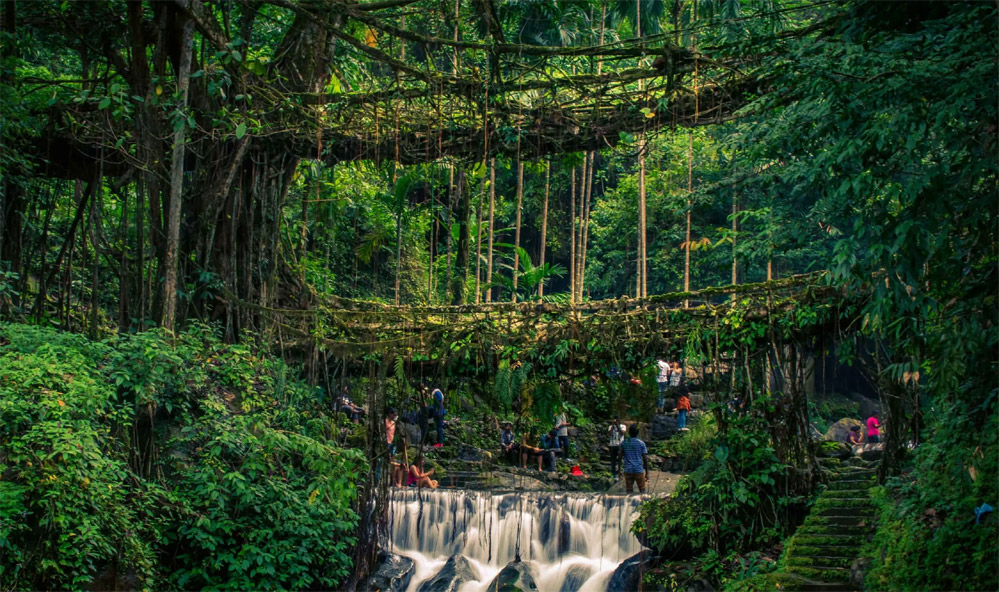
1. Umshiang Double-Decker Root Bridge, Nongriat
The crown jewel and most famous of all living root bridges, this two-tiered structure stands at 2,400 feet elevation near Cherrapunji.
Key Facts:
- Age: Estimated 180+ years old
- Structure: Two functional bridges stacked vertically
- Upper Bridge: 20 meters long
- Lower Bridge: Fully developed crossing
- Trek Distance: 3 km one way
- Steps: Approximately 3,000-3,500 (descent and ascent)
- Trek Duration: 3-5 hours round trip
- Difficulty: Moderate to challenging
Trek Details:
A 2025 trekker described the experience: "The trek involves a total climb of around 3000 steps one-way. It is not a trail, but steps all the way. You have to climb down to the river and then climb up on the other side" Facebook - Adventure Group.
According to Just Wravel's 2025 guide: "The trek to the Double Decker Living Root Bridge is approximately 3 km (one way), with a steep descent and climb of over 3,000 steps. While the path is well-marked, the trek is considered moderate to challenging, requiring good stamina and comfortable footwear" Just Wravel.
What to Expect:
- First 2,000 steps are steep descent through dense forest
- Multiple rest points with small shops selling tea, Maggi, and snacks
- Single-decker root bridge appears after approximately 1.5 hours
- Double-decker bridge requires additional 30-45 minutes
- Optional extension: Rainbow Falls (additional 1 hour trek)
Entry & Fees:
- Entry: ₹50 per person
- Guides: ₹300-500 (optional but recommended for first-timers)
- Closed on Sundays (including Rainbow Falls)
- Best Time: October to March (avoid monsoons when steps become treacherous)
A TripAdvisor reviewer in 2025 noted: "The hike to the double dekker root bridge was a fun and beautiful experience on my 5-day travels through Meghalaya! We took the challenge to include the Rainbow Falls. You can get food and fresh lemon juice along the trek, which especially helps completing the 3500 steps from the double dekker root bridge back to the start" TripAdvisor.
Overnight Option: Nongriat village offers basic homestays (₹400-800 per night) allowing you to experience village life and tackle the return climb with fresh legs.
2. Riwai Living Root Bridge (Near Mawlynnong)
A far more accessible option, this single-decker bridge near Asia's cleanest village offers a gentler introduction to living root bridge experiences.
Key Facts:
- Location: 3 km from Mawlynnong village, 90 km from Shillong
- Trek Distance: Approximately 1 km (15-20 minutes)
- Difficulty: Easy to moderate
- Structure: 17-meter-long single-decker bridge
- Best Combined With: Mawlynnong village tour
A TripAdvisor reviewer shared: "It is beautiful and easily accessible. Around a 15-minute trek, like everywhere else in Meghalaya, you climb down the steps first to reach the bridge, and then climb back up" TripAdvisor.
Perfect For: Families, elderly travelers, or those wanting the experience without extreme physical exertion.
3. Wah Myor Living Root Bridge
Recently gaining attention as one of Meghalaya's highest living root bridges.
Key Facts:
- Location: Near Krohiawhiar village
- Trek: 2-hour downhill through dense forest
- Unique Feature: Towers high above the river
- Difficulty: Moderate
An Instagram post from December 2025 described it: "It's a moderate two hour downhill hike through dense forest before the bridge finally comes into sight. The bridge towers high above the river" Instagram.
4. Other Notable Bridges:
- Rangthylliang Root Bridge: Near Pynursla
- Mawkyrnot Living Root Bridge: Described as "exhilarating yet peaceful" in dense forest settings
- Kudengrim Root Bridge: Traditional Khasi construction
VISITOR TESTIMONIALS: REAL EXPERIENCES
A Medium blogger in 2020 reflected: "It took us nearly 3 hours to reach the location. It was a calm and peaceful place, surrounded by mountains and big trees. Crystal Clear Water... These Living Root Bridges are a wonderful trip and a lesson in caring for the environment" Medium.
A December 2024 TripAdvisor reviewer wrote about Mawkyrnot bridge: "The whole trail, the bridges, everything is in the dense forest and the experience is exhilarating yet peaceful and calming as there were no crowds" TripAdvisor.
An Instagram traveler in November 2025 admitted: "A TREK TO DOUBLE DECKER BRIDGE! And I admit that it's one of the toughest treks... The trek to bridge is almost 3km long and 3500+ steps. Going down is easier, but return is more tiring. It takes whole day, but worth seeing this natural wonder" Instagram.
UNESCO WORLD HERITAGE NOMINATION: GLOBAL RECOGNITION
In a momentous development, Meghalaya's Living Root Bridges took a major step toward UNESCO World Heritage recognition in January 2026. The nomination dossier was officially submitted, marking progress in a journey that began with the site's inclusion on UNESCO's Tentative List in 2022 Hub Network.
According to UNESCO's documentation, the bridges are nominated under the category of "Cultural Landscapes," described as: "Locally known as Jingkieng Jri, Living Root Bridges (LRB) are Ficus-based rural connectivity and livelihood solutions within dense subtropical moist broadleaf forest eco-region of Meghalaya in the eastern extension of the Indian Peninsular Plateau" UNESCO.
Finance Minister Nirmala Sitharaman expressed support in July 2025: "Meghalaya first submitted a proposal to UNESCO in 2018, nominating the living root bridges for inclusion in the World Heritage list under the category of cultural landscapes" MSN India.
An Instagram post from Meghalaya Tourism on January 15, 2026, celebrated: "A moment of pride for Meghalaya as the state moves a step closer to achieving UNESCO World Heritage Status for Living Root Bridges" Instagram - Meghalaya Tourism.
CONSERVATION & CONTEMPORARY CHALLENGES
While these bridges have survived centuries, they now face modern threats:
Challenges:
- Over-tourism: Increased foot traffic can damage young roots
- Climate Change: Altered rainfall patterns affect tree health
- Knowledge Loss: Younger generations less interested in traditional techniques
- Development Pressure: Modern infrastructure threatening natural settings
Conservation Efforts:
- UNDP India has initiated programs to document and preserve traditional bridge-building knowledge
- Local communities are establishing tourism guidelines to protect bridges
- Research institutions are studying structural properties for contemporary applications
- UNESCO nomination process has increased awareness and protection measures
PRACTICAL INFORMATION FOR VISITORS
Best Time to Visit:
- October to March: Ideal weather, clear trails, lower water levels
- April-May: Warm but manageable
- June-September: Monsoon makes treks dangerous—slippery steps, leeches, poor visibility
What to Bring:
- Sturdy trekking shoes with excellent grip (most important item!)
- Walking stick (available for rent at trailheads ₹20-50)
- Minimum 2 liters of water per person
- Energy snacks (trail mix, energy bars, chocolates)
- Small first-aid kit
- Extra pair of socks
- Light raincoat (even in dry season)
- Insect repellent
- Sunscreen and hat
- Portable charger for phones
What NOT to Do:
- Attempt the Double-Decker trek during monsoons
- Underestimate the physical challenge (it's harder than it looks!)
- Ignore hydration (dehydration is common)
- Rush the trek (pace yourself, enjoy the journey)
- Damage or remove any part of the bridges (they're living organisms!)
Fitness Requirements:
- Double-Decker: Good cardiovascular fitness, strong knees, moderate endurance
- Riwai Bridge: Basic fitness sufficient
- If you can climb 10 flights of stairs without extreme fatigue, you can likely manage Riwai
- If you can hike 3-4 hours with elevation changes, Double-Decker is achievable
THE VERDICT
Living root bridges transcend mere tourist attractions—they represent a philosophical statement about humanity's relationship with nature. In an era obsessed with quick fixes and planned obsolescence, these bridges embody radical patience: the willingness to plant trees whose full potential your grandchildren will witness.
The Double-Decker trek is genuinely challenging, testing both physical endurance and mental resolve. But standing on that moss-covered, centuries-old living structure, watching roots pulse with life beneath your feet while waterfalls roar in the distance, delivers a profound realization: the most extraordinary things in life cannot be rushed, only nurtured.
For those unable to tackle the extreme trek, Riwai bridge offers 80% of the wonder with 20% of the effort—proving that marvel isn't measured in steps climbed, but in perspective gained.
These bridges aren't just feats of indigenous engineering; they're templates for survival on a warming planet, where working with nature rather than against it isn't romantic idealism but practical necessity.
Recommended Experience Level:
- Double-Decker: Fit adventurers, nature enthusiasts, photography lovers
- Riwai: Families, casual hikers, elderly travelers (with basic mobility)
Skip If: You have serious knee problems, cardiovascular issues, or expect an easy walk (for Double-Decker)
For detailed trek guides, homestay bookings, and conservation support information, visit www.shillong.com