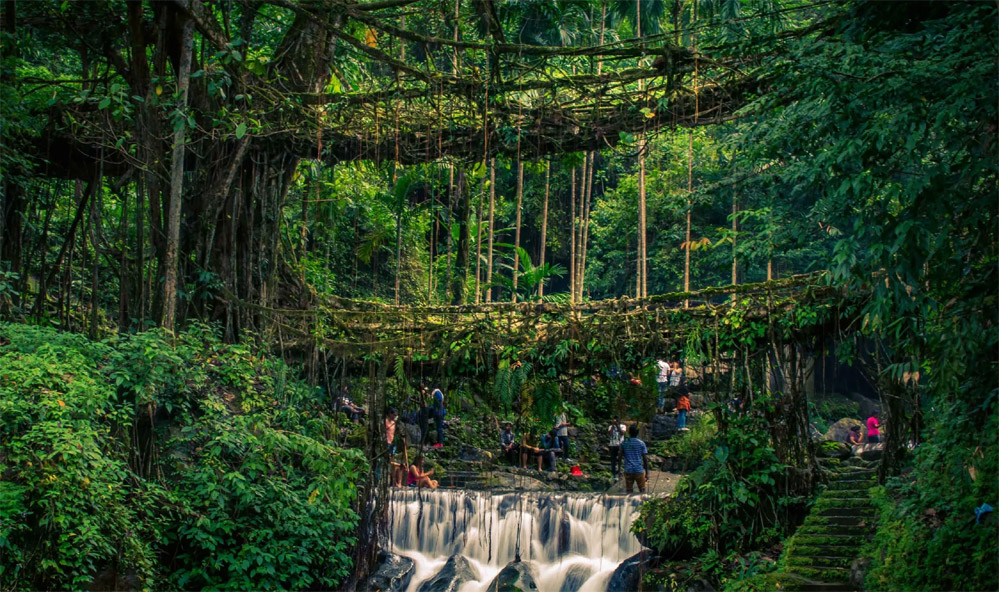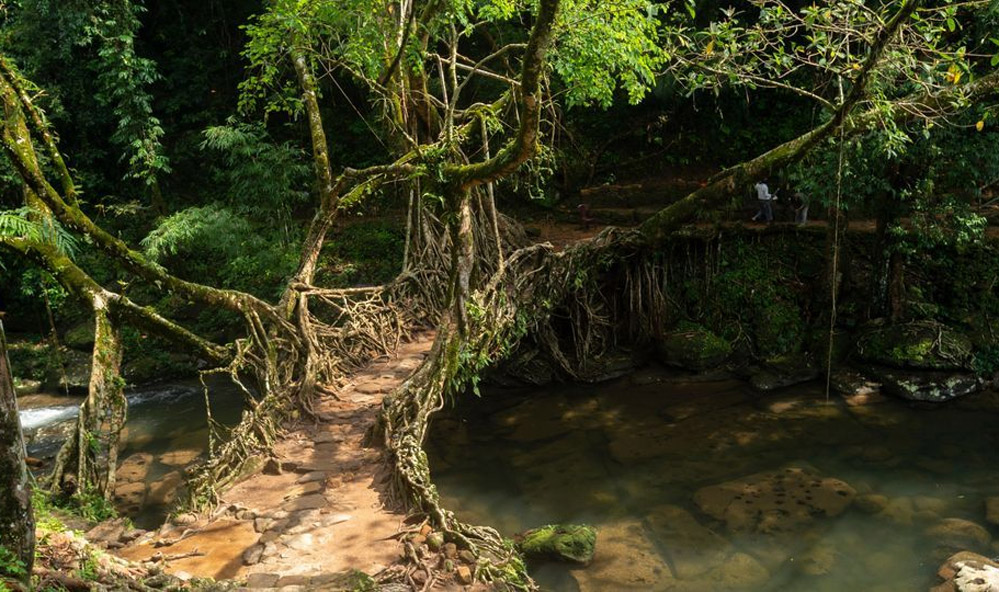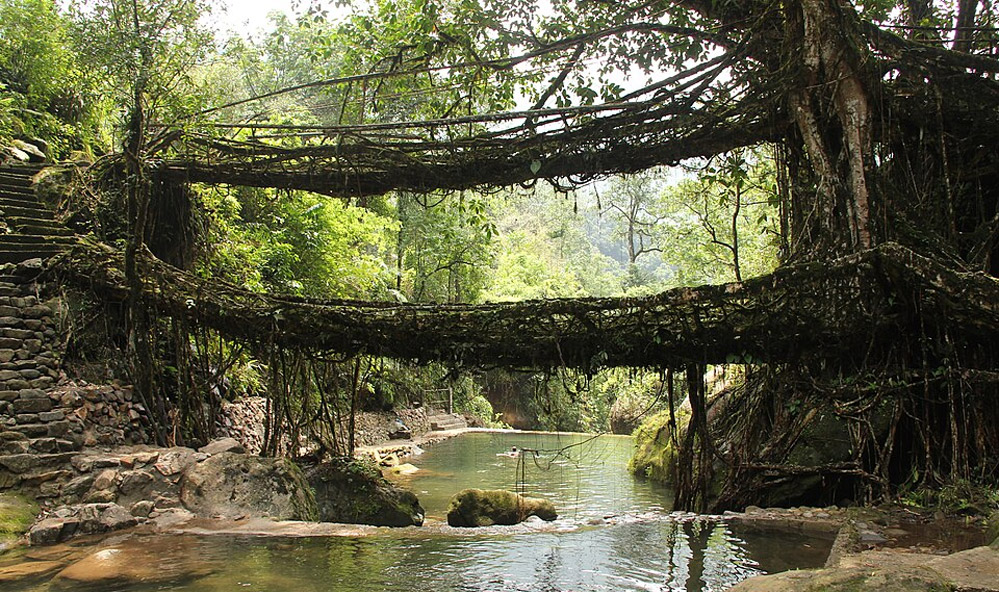
The living root bridges of Meghalaya (locally called Jingkieng Jri) are grown, not built. The Khasi and Jaintia people train the aerial roots of the rubber fig tree (Ficus elastica) across streams and rivers until they form strong, walkable bridges. Some are more than a hundred years old and still getting stronger.
There are roughly a dozen of these bridges in the state. The two that most visitors aim for are the Double Decker Root Bridge near Nongriat and the much easier Riwai Root Bridge near Mawlynnong.
Quick Facts
- Grown from the roots of the rubber fig tree
- Most famous: Double Decker Root Bridge, Nongriat
- Easier option: Riwai Root Bridge (near Mawlynnong)
- Best time: October to March
- Starting point for Double Decker: Tyrna village (about 1.5–2 hours from Shillong)
- Trek difficulty: Easy (Riwai) to moderately hard (Double Decker)
1. Double Decker Living Root Bridge, Nongriat
This is the one most people come to see — two bridges stacked one above the other.
Key details
- Age: estimated 180+ years
- Upper bridge length: about 20 metres
- Trek distance: roughly 3 km one way
- Steps: around 3,000–3,500 (down and then up again)
- Time needed: 3–5 hours round trip
- Difficulty: Moderate to challenging
- Entry fee: ₹50
- Guide (optional): ₹300–500
- Closed on Sundays
The trek
The trail starts at Tyrna village. The first stretch is a long, steep descent through forest. There are small shops along the way selling tea, Maggi and snacks. After about 1.5 hours you reach a single-decker root bridge. The Double Decker is another 30–45 minutes further. Many people also continue to Rainbow Falls (extra 1 hour).
The climb back up is the hardest part. Good shoes and reasonable fitness make a big difference.
Overnight option
Basic homestays in Nongriat village cost around ₹400–800 per night. Staying overnight lets you do the return climb with fresher legs and see the village properly.
2. Riwai Living Root Bridge (near Mawlynnong)
A much gentler option, only about 15–20 minutes’ walk from the road.
Key details
- Location: 3 km from Mawlynnong, about 90 km from Shillong
- Trek: roughly 1 km, mostly steps
- Difficulty: Easy to moderate
- Bridge length: about 17 metres
- Best combined with a visit to Mawlynnong village
This is the better choice for families, older travellers, or anyone who wants to see a living root bridge without a full-day trek.
Other Bridges
- Wah Myor – higher above the river, moderate two-hour downhill trek
- Rangthylliang – near Pynursla
- Mawkyrnot – quiet forest setting, fewer crowds
How to Reach from Shillong
Double Decker (Nongriat)
Shillong → Tyrna village (approx. 58–60 km, 1.5–2 hours by cab). The trek starts at Tyrna. Most people hire a cab for the day or join a local tour.
Riwai Bridge
Shillong → Mawlynnong (about 90 km). From Mawlynnong it is a short drive + 15–20 minute walk to the bridge. Easy to combine with a Mawlynnong village visit.
Best Time to Visit
- October to March — best overall. Clear trails, lower water, comfortable weather
- April–May — warmer but still doable
- June to September (monsoon) — not recommended for the Double Decker. Steps become very slippery and streams can rise quickly
What to Carry
- Shoes with good grip (most important)
- Walking stick (often available for rent at the start)
- At least 2 litres of water
- Snacks
- Light raincoat
- Insect repellent
- Basic first-aid
Which One Should You Do?
Double Decker — Full day, moderately hard. Best for fit travellers and photographers.
Riwai — 1–2 hours, much easier. Best for families, first-timers and older visitors.
If you have the fitness and a full day, the Double Decker is worth the effort. If you want the experience without the long climb, do Riwai (and visit Mawlynnong at the same time).
Practical Tips
- Start early for the Double Decker so you are not climbing back in the heat
- The return climb is harder than the descent — pace yourself
- Do not try the Double Decker trek in heavy rain
- The bridges are living. Do not cut, pull or damage the roots